

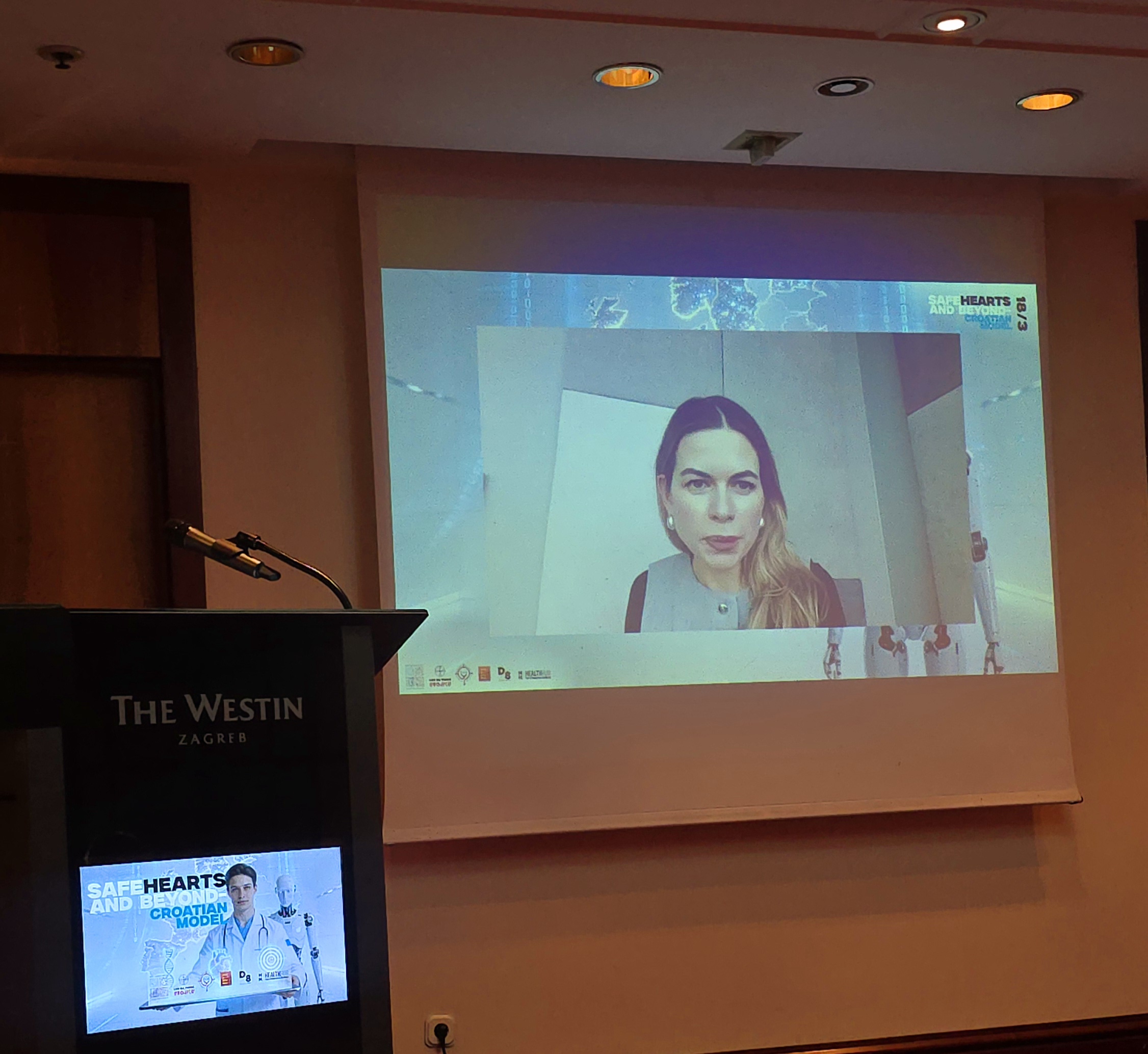
“SAFEHEART and Beyond – The Croatian Model 2026”; Radka Lang (EFPIA Cardiovascular Health Platform): “Cardiovascular prevention would only succeed through partnership.”
he fourth session of the forum “SAFEHEART and Beyond – The Croatian Model 2026” was “Next-Generation Prevention – Data, Diagnostics and Primary Care”, focused on innovation and system sustainability. Radka Lang (MSD), Vice-Chair of the EFPIA Cardiovascular Health Platform emphasised that innovation must be understood broadly — not only as technological advancement, but also as new models of care, better use of data and stronger integration of prevention into health systems.

Radka Lang (MSD), Vice-Chair of the EFPIA Cardiovascular Health Platform
Cardiovascular disease remains the leading cause of death in Europe. As you probably heard many times today, not because we lack knowledge or innovation, but because we still act too late.
We know how to prevent cardiovascular disease.
We know how to measure. We know what works.
But the real challenge is whether we are willing to organize our systems around early action rather than late intervention. And this is why this discussion matters. When we talk about innovation for safer hearts, we should be clear.
Innovation is not only about new therapies. It is also about how we organize care, how we use data, and how we turn information into action. This was very clear in the recent high level discussion organized by ESC and Cyprus on high quality data sets for high quality care. One message stood out data only improves outcomes when it is visible, comparable and used for action and without minimum standardized cardiovascular data set. We cannot see variation, we cannot identify gaps, and we cannot improve outcomes.Dashboards without robust comparable data may look impressive, but they do not change care.
And this is why initiatives like ”Know Your number” by 35, a concept which originated in Croatia, actually become so important. “Know your numbers is not a slogan. It’s a practical approach to early prevention. By the age of 35, everyone, according to our opinion, should receive a baseline cardiovascular risk assessment delivered in primary care and admitted into routine care. The baseline check should be comprehensive but simple. It should include blood pressure, lipid profile, including LDL cholesterol, blood glucose, measures of overweight and obesity, smoking status, and family history. In addition, lipoprotein (a) should be measured at least once in lifetime.

Given its role in inherited cardiovascular risks, these are not new or complex tests. What is innovative is measuring them early, measuring them consistently, and ensuring the data is used to guide, follow up, and care and prevention also must reflect genetics. Paediatric screening for FH should follow European recommendations, including those referenced in the Prague Declaration.
So inherited risk can be identified early and manage appropriately. Risk assessment should use validated European risk tools with earlier and more frequent checks for people at higher risk, especially those with familial hypercholesterolaemia and elevated lipoprotein (a) and this is why standardization matters.
When the same indicators are measured in the same way, variation becomes visible so that it can be acted upon. And when indicators such as LDL cholesterol are linked to care pathways, data becomes a tool for better outcomes, not just for reporting. And this logic is central to EU Safe Hearts Plan. Measure what matters, make it visible, and act from EFPIA perspective.
We strongly welcome the EU Safe Hearts Plan as an important step toward a more coordinated European approach to cardiovascular prevention. To turn this ambition into reality, we now call for rapid adoption for an EU Council recommendation on cardiovascular health checks. This would help anchor early detection, data collection and follow up across Member States while allowing national adaptation.
Cardiovascular prevention would only succeed through partnership. Policymakers, clinicians, patient organisations, public health authorities and industry all have a role to play.
We all have a role to play.
EFPIA is committed to be a constructive partner, supporting implementation, contributing evidence and helping ensure that innovation delivers what matters most.
For fewer events, better outcomes, and safer hearts across Europe.
Key Conclusions of the Forum
The discussions throughout the forum confirmed that cardiovascular disease remains the leading cause of death and disability in Europe, with a particularly high burden in Central and Eastern Europe. Despite strong scientific evidence and available tools, prevention continues to be underutilised, while health systems remain predominantly oriented toward late-stage treatment rather than early, proactive intervention.
Participants emphasised that meaningful progress requires a systemic shift — from reactive to preventive care, from fragmented to integrated pathways, and from isolated interventions to coordinated, data-driven strategies that place patients at the centre.
The Croatian model was recognised as a comprehensive and scalable example of such an approach. It is built on a life-course prevention pathway that begins with national preschool screening for familial hypercholesterolaemia, enabling early identification of high-risk individuals and families. It is further strengthened through innovative, creative and continuous public health campaigns, such as „The Hunt for the Silent Killer“, „Do You Know Your Number?” and „Mission 70/26“, which combine multidisciplinary approach, awareness, screening and citizen engagement at scale.
The Croatian model also integrates multidisciplinary care, including the active involvement of nurses, or pharmacists throughout digital platforms in central health information system (PILK), supporting coordinated management of patients with cardiovascular and other non-communicable diseases. In addition, national preventive health examinations play a key role in systematically identifying at-risk populations and connecting them to care pathways.
A strong emphasis is placed on harm reduction policies, particularly in addressing obesity, tobacco use, salt intake and sugar consumption, recognising that incremental reductions in risk factors can deliver substantial population health benefits.
Importantly, participants highlighted the need to establish a broader social compact for cardiovascular health, based on the principle of “cardiovascular health in all policies”, ensuring that prevention is embedded across sectors and supported at all levels of society, taking into consideration the impact of all risk factors.
Furthermore, strengthening the pharmacoeconomic perspective was identified as essential, as growing evidence shows that timely prevention and the introduction of innovative therapies not only improve health outcomes, but also generate significant long-term returns for both society and the economy.
The role of digital innovation and artificial intelligence was also emphasised, particularly through tools such as the AI assistant Zdravko, which supports prevention, awareness and early management of non-communicable diseases.
Call to Action 2026–2030
The forum concluded with a strong and unified commitment to accelerate cardiovascular prevention across Europe, with a particular focus on Central and Eastern Europe.
We commit:
We commit to strengthening data-driven prevention strategies and improving the use of health data to guide policy, monitor outcomes and reduce inequalities.
We commit to accelerating early detection and screening programmes, including innovative approaches such as preschool screening for familial hypercholesterolaemia and population-level risk identification.
We commit to investing in primary healthcare and multidisciplinary models of care, including the active involvement of pharmacists and the use of digital platforms to ensure integrated and continuous patient management.
We commit to implementing comprehensive harm reduction policies, targeting key risk factors such as obesity, tobacco use, salt and sugar consumption, in order to achieve measurable improvements in population health.
We commit to scaling innovative public health campaigns that are creative, continuous and citizen-centred, ensuring sustained engagement and awareness across all age groups.
We commit to strengthening the pharmacoeconomic framework for cardiovascular health, recognising that investment in prevention and innovation delivers long-term value, improved outcomes and significant societal and economic returns.
We commit to accelerating the adoption of digital and AI-supported solutions, including tools such as the AI assistant Zdravko, to support prevention, early detection and patient empowerment.
We commit to establishing a cross-sectoral social compact for cardiovascular health, based on the principle of “health in all policies”, ensuring coordinated action across government, healthcare, academia, industry and civil society.
We commit to reducing inequalities in cardiovascular outcomes across Central and Eastern Europe through stronger collaboration, knowledge exchange and scaling of best practices.
We commit to placing patients and citizens at the centre of all prevention strategies, strengthening health literacy, engagement and shared responsibility for health.
PHOTOGALLERY //
https://www.facebook.com/media/set/?vanity=HealthHub.HR&set=a.959911699746150